Why Does My Furnace Keep Turning On and Off in St. Charles, MO?
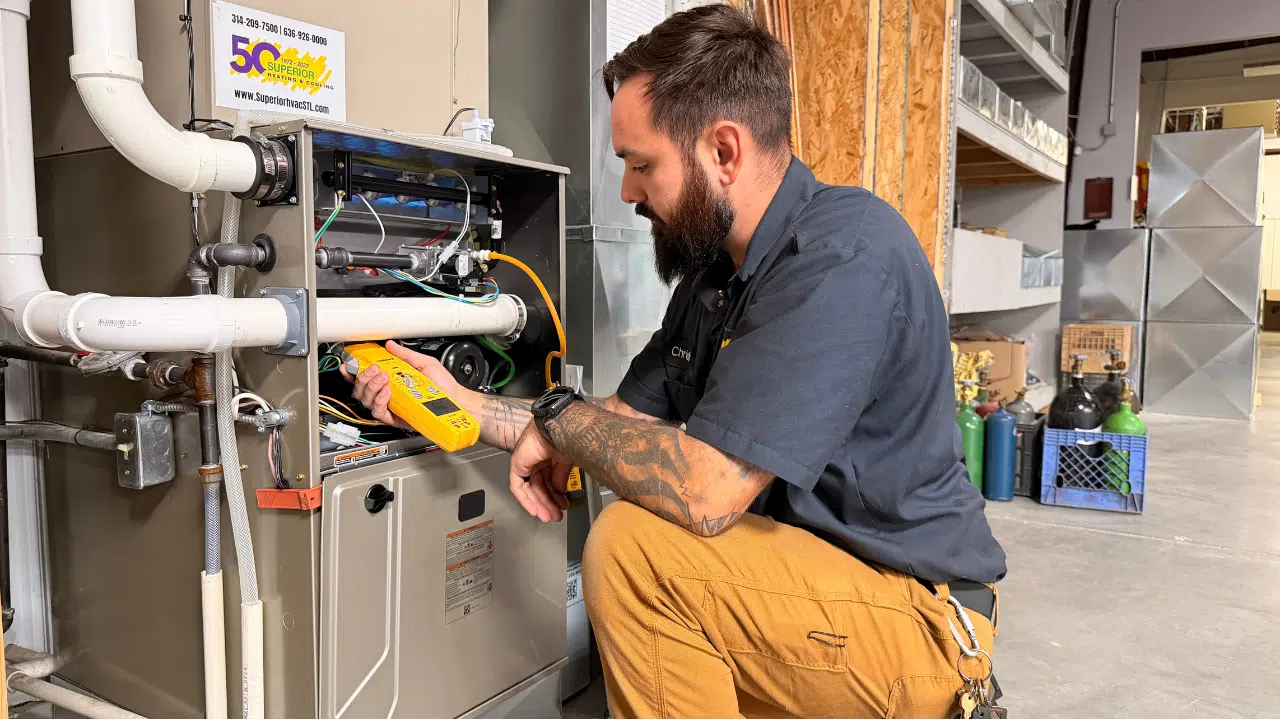
If your furnace keeps turning on and off before your St. Charles home reaches the temperature on the thermostat, your heating system may be short cycling. Short cycling happens when a furnace repeatedly starts, runs for only a short period, shuts down, and then starts again soon afterward.
A furnace is supposed to cycle on and off. That part is normal.
What is not normal is hearing the system start every few minutes, watching the thermostat struggle to reach the temperature you selected, or noticing that the furnace shuts down almost as soon as warm air begins coming from the vents.
There are several possible reasons this happens. Some are relatively simple, such as restricted airflow from a dirty filter. Others can involve the thermostat, safety controls, furnace sizing, or problems inside the heating equipment.
The important thing is to figure out why the furnace is ending its heating cycle early instead of assuming the furnace automatically needs replacement.
Here are some of the most common causes we look at when a furnace keeps turning on and off.
What Is Furnace Short Cycling?
Furnace short cycling means the heating system repeatedly starts and stops without completing a normal heating cycle.
Carrier describes short cycling as a furnace turning on and off repeatedly in cycles that may last less than roughly five to ten minutes. The exact cycle length can vary depending on the home, equipment, thermostat setting, and outdoor conditions, so there is no single timer that applies to every furnace.
The pattern matters more than timing one cycle with a stopwatch.
For example, pay attention if:
- The furnace starts several times within a short period.
- The thermostat never reaches its set temperature.
- Warm air begins coming from the vents, then suddenly stops.
- The furnace shuts down and restarts over and over.
- Certain rooms never seem to warm up before the furnace stops.
- Your heating system behaves differently than it did during previous winters.
One unusual cycle does not necessarily mean you have a problem. A repeated pattern is what deserves attention.
1. Start With Your Furnace Filter
One of the simplest places to start is the air filter.
Your furnace needs a steady supply of return air moving through the system. When a filter becomes heavily clogged with dust and debris, airflow can become restricted. That can do more than reduce the amount of air coming from your vents.
In some situations, restricted airflow can contribute to excessive heat building up inside the furnace. Modern furnaces include safety controls designed to shut the equipment down when unsafe temperatures are detected. After the furnace cools, it may start again.
From the homeowner’s perspective, the result can look like this:
Furnace starts → warm air comes out → furnace shuts off → furnace cools → furnace starts again.
If your furnace keeps cycling, check the filter according to the manufacturer’s instructions. Do not assume that a thicker or more restrictive filter is automatically better. Filters need to be compatible with the HVAC system’s airflow requirements.
If you recently switched to a different type of filter and the short cycling started around the same time, mention that to your HVAC technician.
2. Make Sure Your Supply and Return Vents Are Open
Your HVAC system depends on air moving through both sides of the system. Supply vents deliver conditioned air into your rooms. Return grilles allow air to move back toward the equipment so it can be heated again. If furniture, rugs, boxes, or other objects are blocking those openings, airflow can suffer.
Walk through your St. Charles home and check:
- Supply registers
- Return-air grilles
- Vents behind furniture
- Floor registers covered by rugs
- Rooms where vents may have been manually closed
We generally do not recommend closing a large number of supply vents in an attempt to redirect heat elsewhere. Your duct system and furnace are designed around a certain amount of airflow. Dramatically changing that airflow can create pressure and comfort issues rather than solving them.
If one area of the home is consistently colder than another, that is something to investigate separately rather than trying to force the system to compensate by shutting vents around the house.
3. The Furnace May Be Shutting Down Because It Is Overheating
A furnace contains safety controls designed to prevent dangerous operating temperatures. One important control is the high-limit switch.
If the furnace gets too hot, the system may shut the burners off to protect the equipment. Once the temperature drops, the furnace may attempt another heating cycle. Restricted airflow is one possible reason this happens, but it is not the only possibility. A blower problem, duct restriction, improper system setup, or another internal issue may also contribute. This is why replacing the filter is a reasonable first check but not a complete diagnosis.
If you install a clean, appropriate filter and the furnace continues shutting down repeatedly, do not keep resetting the equipment or attempting to bypass safety controls. A safety switch activating repeatedly is a symptom.
The next question should be:
Why is the furnace reaching a condition that causes the safety control to stop the heating cycle?
That is the problem we want to find.
4. Your Thermostat Could Be Contributing to the Problem
The thermostat tells your furnace when the house needs heat and when the heating cycle should stop.
If the thermostat is not sensing the temperature accurately, is installed in a poor location, has wiring or configuration issues, or is not communicating properly with the HVAC system, furnace operation can become inconsistent.
Think about where your thermostat is located.
Is it:
- Near a supply vent?
- In direct sunlight?
- Close to an exterior door?
- Near a fireplace?
- In a particularly warm hallway?
- On a wall that experiences unusual temperature changes?
A thermostat in an area that warms faster than the rest of the house may tell the furnace that heating is no longer needed even though other rooms are still cold.
Modern smart thermostats can also use remote temperature sensors to help manage temperature differences in some homes. ENERGY STAR notes that compatible temperature sensors can help thermostats monitor rooms with different temperatures caused by factors such as insulation and sun exposure.
That does not mean every short-cycling furnace needs a smart thermostat. It simply means the thermostat and its location should be part of the diagnosis.
5. A Furnace That Is Too Large Can Cycle Differently
Homeowners often assume a larger furnace must be better because it can produce more heat. That is not necessarily true. An HVAC system should be sized for the heating requirements of the house.
A furnace with substantially more heating capacity than the home needs can sometimes raise the temperature around the thermostat quickly and shut down before heat is evenly distributed throughout the house. Then temperatures fall again, and another heating cycle begins. The result can be frequent starts and stops along with uncomfortable temperature differences between rooms.
That does not mean every furnace that cycles frequently is oversized. Short cycling can have several possible causes, and equipment sizing should be evaluated based on the home’s heating load, system design, ductwork, and equipment specifications rather than guessed from cycle length alone.
If short cycling has existed since the furnace was installed, mention that history to your technician. A problem that started suddenly last week tells us something very different from a system that has behaved the same way for ten winters.
6. The Flame or Ignition System May Be Having Trouble
A gas furnace needs to safely ignite and confirm that the burners are operating correctly. If something interferes with the ignition sequence or flame detection, the furnace may attempt to start but shut down before completing a normal cycle.
You may notice:
- The furnace attempting to ignite repeatedly.
- Burners lighting and then shutting off quickly.
- Clicking or ignition sounds followed by silence.
- The blower operating without sustained heat.
- The system locking out after several attempts.
These are not components we recommend homeowners disassemble or adjust themselves.
Gas valves, burners, ignition systems, flame-sensing components, electrical controls, and safety devices require proper testing. If the furnace is repeatedly attempting to ignite, schedule service instead of continuing to cycle power and hoping the problem clears itself.
If You Smell Gas, Treat It Differently
A suspected natural-gas leak is not a normal furnace troubleshooting situation. If you smell gas, leave the home and contact your gas utility or emergency services from a safe location. Do not operate electrical switches, thermostats, appliances, or other devices while you are inside the building.
7. Ductwork Problems Can Contribute to Short Cycling and Uneven Heating
Your furnace can only work properly when conditioned air can move through the house. Leaking, damaged, undersized, disconnected, or poorly designed ducts can make temperature control more difficult.
ENERGY STAR identifies duct problems as one potential reason homeowners experience high heating costs and uneven temperatures between rooms. For example, suppose the thermostat is near the center of the house while several bedrooms are located at the end of long duct runs. The furnace heats the area around the thermostat quickly. The thermostat reaches its setting and ends the heating cycle.
Meanwhile, those farther rooms still feel cold. You may interpret that as a furnace problem when part of the issue is actually how heat is being distributed.
This is another reason we look at the entire heating system instead of focusing only on the furnace cabinet.
8. How Often Should a Furnace Normally Run?
There is no single “correct” number of furnace cycles per hour that applies to every St. Charles home.
Cycle length depends on variables such as:
- Outdoor temperature
- Thermostat setting
- Home insulation
- Furnace size
- Furnace staging
- Duct design
- Heat loss through windows and doors
- Building size
- Thermostat programming
A furnace will naturally run more during colder weather because your home is losing heat more quickly. What we pay attention to is whether the system completes meaningful heating cycles and maintains the indoor temperature comfortably. If your furnace repeatedly runs for only a few minutes and shuts off while the house remains below the thermostat setting, that deserves a closer look.
Carrier specifically notes that short cycling can contribute to uneven heating, unnecessary energy use, and additional equipment wear.
9. Does Short Cycling Increase Your Heating Bill?
It can. Starting and stopping repeatedly can prevent your furnace from operating through normal heating cycles and may contribute to inefficient operation.
But we would not diagnose short cycling simply because your gas or electric bill increased. Weather plays a major role in heating costs. So do energy prices, thermostat settings, occupancy changes, insulation, air leakage, and equipment condition.
Instead, compare several pieces of information:
- Has your furnace started cycling more often?
- Is the house less comfortable?
- Has your thermostat setting stayed similar?
- Has your energy usage increased compared with similar weather conditions?
Those observations together provide much better information than the bill alone.
10. Can You Fix Furnace Short Cycling Yourself?
There are a few basic checks homeowners can safely make.
Start with:
- Check the thermostat setting. Make sure it is set to HEAT and the temperature is where you expect it to be.
- Inspect the furnace filter. Replace it if needed using a filter appropriate for your system.
- Check your vents. Make sure supply and return openings are not blocked.
- Look at the thermostat location. Consider whether a nearby heat source or unusual airflow could be affecting the reading.
- Pay attention to the cycling pattern. Record approximately how long the furnace runs and whether your indoor temperature rises.
Then stop.
We do not recommend opening the furnace cabinet, bypassing safety switches, adjusting gas components, manipulating electrical connections, or repeatedly resetting breakers to troubleshoot a cycling problem.
Those steps should be handled by a qualified HVAC technician.
What Should You Tell Your HVAC Technician if Your Furnace Keeps Turning On and Off?
You do not need to diagnose the furnace before scheduling service. Instead, give us information about the pattern.
For example:
“The thermostat is set to 70 degrees, the house is 66, and the furnace starts for about four minutes before shutting off. A few minutes later it starts again.”
That is much more useful than simply saying, “My furnace is acting weird.”
Also mention:
- When the problem started
- Whether you recently changed the filter
- Whether a new thermostat was installed
- Which rooms feel cold
- Whether airflow seems weaker than usual
- Any unusual noises
- Any error codes or flashing lights you noticed
- Whether the furnace has recently been serviced
A short phone video of the thermostat and normal operating behavior can sometimes help document an intermittent problem, as long as you can record it safely without opening the equipment.
Does Short Cycling Mean You Need a New Furnace?
Not automatically. Short cycling is a symptom, not a replacement recommendation.
The cause may involve airflow, the thermostat, an electrical or control issue, ignition components, the furnace itself, the duct system, or the relationship between the equipment and the home.
Replacement becomes a separate conversation when the diagnosis points toward major equipment problems and factors such as age, condition, repair history, efficiency, and repair cost make replacing the system more practical.
Superior already has a separate guide about signs that an HVAC system in St. Charles may need replacement. Short cycling deserves its own diagnosis before reaching that conclusion.
Our approach is simple:
Find out why the system is cycling first. Then decide what actually needs to be repaired or changed.
Frequently Asked Questions
Why does my furnace keep turning on and off every few minutes?
If your furnace repeatedly runs for only a few minutes before shutting down and restarting, it may be short cycling. Common causes include a dirty air filter, blocked vents, thermostat problems, restricted airflow, or an improperly sized furnace.
Can a dirty furnace filter cause short cycling?
Yes. A clogged filter can restrict airflow through the furnace, causing heat to build up inside the system. This can trigger a safety limit that shuts the furnace down until it cools, leading to repeated starts and stops.
Can a bad thermostat make my furnace turn on and off?
Yes. Incorrect thermostat settings, poor placement, wiring problems, or a malfunctioning thermostat can cause the furnace to cycle improperly. A thermostat near direct sunlight, drafts, or another heat source may also read the room temperature inaccurately.
Why does my furnace shut off before reaching the thermostat temperature?
Restricted airflow is one possible cause. A dirty filter or blocked vents can cause the furnace to overheat and shut down before your home reaches the selected temperature. Thermostat or mechanical issues can create similar symptoms.
Does short cycling mean I need a new furnace?
No. Short cycling is a symptom, not proof that your furnace needs replacement. The cause may be something repairable, such as an airflow restriction or thermostat issue. Replacement is usually a separate decision based on the furnace’s age, condition, repair history, and the specific problem found during diagnosis.
Furnace Repair in St. Charles, MO
A furnace that repeatedly starts and stops can make your home uncomfortable and put unnecessary stress on the heating system.
At Superior Service, we provide furnace repair, HVAC maintenance, and heating services for homeowners throughout St. Charles and the surrounding St. Charles County area.
Our technicians can evaluate the furnace, thermostat, airflow, controls, and other parts of the heating system to help determine why your equipment is not completing normal heating cycles.
If your furnace keeps turning on and off, you do not need to guess which component is responsible before calling us.
Tell us what you are noticing, and we can start from there.
Schedule furnace repair with Superior Service in St. Charles and let us help you figure out why your heating system keeps cycling.