

Auxiliary Heat vs Emergency Heat: A Chesterfield Homeowner’s Guide
The difference between auxiliary heat vs emergency heat comes down to how your heat pump uses its backup heating system. Auxiliary heat turns on automatically when additional heating is needed. Emergency heat is generally a manually selected mode that bypasses normal heat-pump heating and uses the backup heat source instead. Seeing “AUX” does not automatically mean something is broken.
Imagine walking past the thermostat in your Chesterfield home and noticing a label you do not remember seeing before. The house feels comfortable, but the screen says “AUX HEAT.” You open the settings and find another option labeled “EMERGENCY HEAT.”
Should you switch it on? Leave everything alone? Schedule a repair?
Before changing anything, it helps to understand what those settings actually control. This guide applies to heat-pump systems with backup heating and compatible thermostat controls, rather than conventional furnace-only systems. Your equipment’s instructions should guide any changes to its operating mode.
Auxiliary Heat vs Emergency Heat: What Changes?
A heat pump normally heats your home by moving heat from outdoors to indoors. Even cold outdoor air contains heat that suitable equipment can collect. That is different from electric resistance heating, which uses electricity to generate heat directly.
When the heat pump needs help, a secondary heat source may become part of the process.
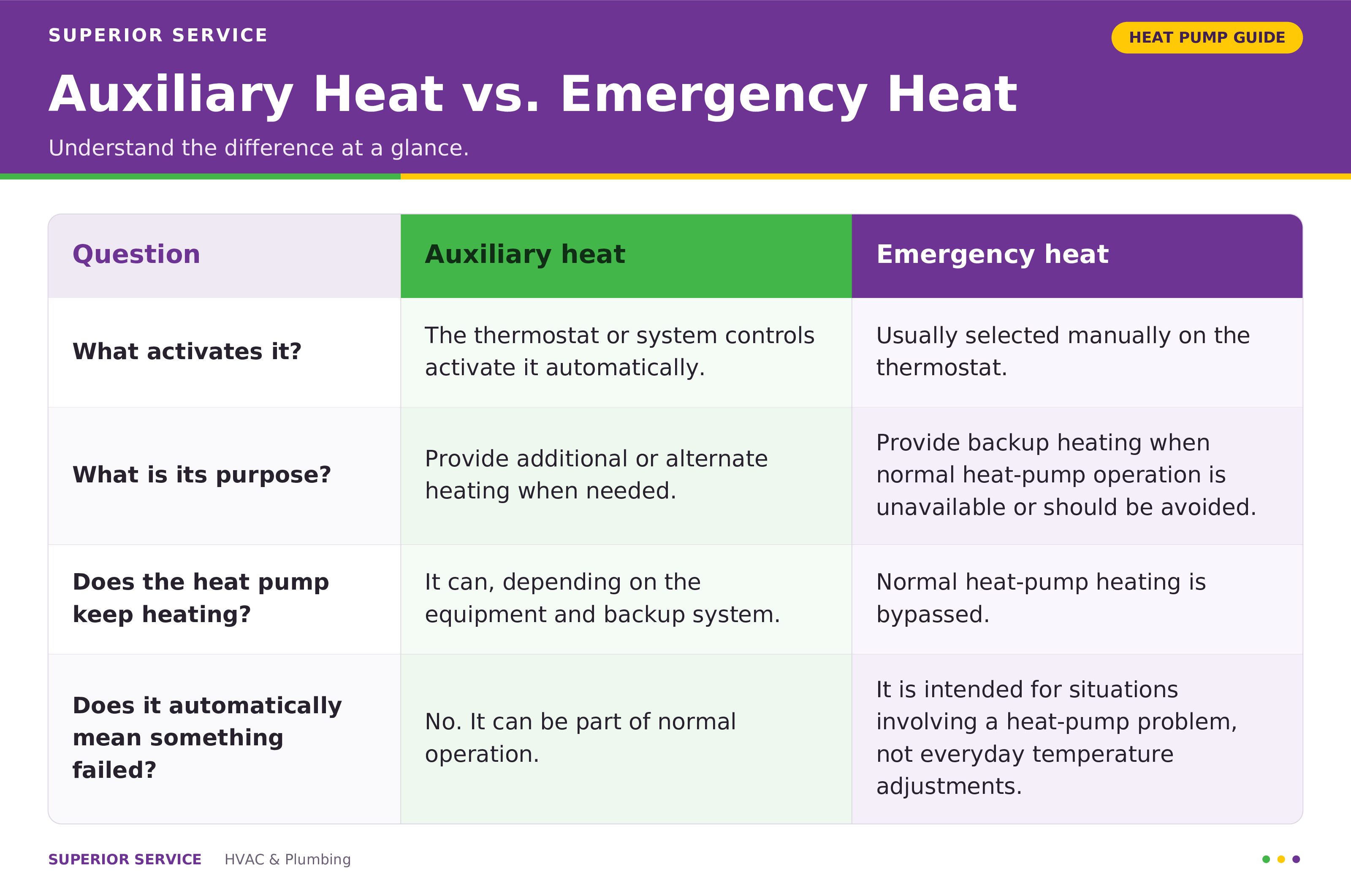
The exact operating sequence depends on your system. Some homes have electric heating strips inside the air handler. Others have a dual-fuel system, pairing a heat pump with a furnace that can take over heating when the controls call for it. Do not assume every backup system runs both heat sources simultaneously.
Does Chesterfield’s Winter Weather Mean You Should Use Emergency Heat?
Cold weather alone is not a reason to manually select emergency heat. A properly configured system manages its normal heating and backup heating through its controls.
Freezing conditions are certainly relevant to heating decisions here. For regional context, the National Weather Service lists a normal January low of approximately 24°F for St. Louis. That is a regional climate reference, not an exact temperature prediction for your Chesterfield property.
However, there is no universal outdoor temperature at which every heat pump needs backup heat. The answer depends on the equipment’s capacity, your home’s heat loss, system sizing, and control settings. A cold-climate heat pump can behave differently from an older, single-stage unit.
That is why a neighbor’s thermostat is not the best benchmark for yours. Two nearby homes can have different equipment and heating requirements.
Our recommendation is to learn how your system is intended to operate instead of following a blanket rule such as “switch to emergency heat whenever it freezes.”
Why Auxiliary Heat May Appear After You Raise the Thermostat
Consider this example: You let the house cool to 64°F overnight, then raise the thermostat to 71°F before getting ready for work.
Depending on the controls, that larger temperature increase may trigger auxiliary heat to help the system reach the new setting. The backup heat could be responding to the temperature change you requested, rather than an equipment failure.
That distinction matters when you are trying to understand a morning pattern. Does “AUX” appear after the programmed temperature increases, then disappear once the house warms up? Or does it remain on throughout the day while the indoor temperature falls?
We recommend checking the schedule before assuming the thermostat or heat pump is defective.
Heat-pump-specific thermostats can manage temperature recovery to reduce unnecessary electric resistance heating. The Department of Energy recommends controls designed to bring the temperature up gradually rather than unnecessarily activating the heating elements.
You do not need to choose between being comfortable and understanding your system. Ask whether your current thermostat schedule is appropriate for your equipment, especially after a thermostat replacement or a change to your daily routine.
Auxiliary Heat Can Also Operate During Defrost
A heat pump’s outdoor coil can develop frost during heating operation. The system periodically uses a defrost cycle to clear it. During that process, auxiliary heat may help maintain indoor comfort while the heat pump temporarily changes its operation.
That means a brief appearance of “AUX” does not necessarily call for intervention.
What deserves attention is thick or persistent ice that does not clear, particularly when the house is also losing heat. A light frost layer that clears during normal operation is different from an outdoor unit remaining encased in ice. Do not chip ice off the coil or remove equipment panels to investigate. Arrange professional service when ice persists.
When Should You Actually Use Emergency Heat?
Emergency heat is intended to provide temporary heating when the heat pump cannot operate properly. It may be appropriate when the outdoor unit has failed or been damaged, or when an HVAC technician specifically directs you to use backup heat while repairs are arranged.
The important word is temporary.
Selecting emergency heat does not repair the outdoor unit. It changes which equipment provides the heat. A house that becomes comfortable in emergency mode may still have an unresolved problem with its primary heating system.
Before using the setting, consult your equipment instructions or contact an HVAC professional to confirm that the backup system can operate safely. Do not repeatedly switch between modes as a troubleshooting experiment.
When you call us, explain what happened before you changed the setting. For example:
“The house stopped warming up in regular Heat mode. I switched to Emergency Heat, and the indoor temperature started rising.”
That observation gives us a useful starting point without requiring you to identify the failed component.
A suspected gas leak is a separate emergency. If you smell natural gas, leave the building without operating electrical switches or equipment. Call 911 or your gas utility from a safe location. Do not try to address a gas smell by changing thermostat modes.
Why Backup Heat Can Affect Your Energy Bill
An air-source heat pump can deliver more heat energy than the electrical energy it consumes because it transfers heat rather than creating all of it directly. Electric resistance backup does not provide that same efficiency advantage.
Consequently, a system relying heavily on electric heating strips can use more electricity than one meeting the same heating demand primarily through efficient heat-pump operation. Occasional necessary backup heating is different from leaving the system in emergency mode unnecessarily.
A dual-fuel system requires a different comparison. Its operating cost depends on electricity and fuel prices, equipment efficiency, and the settings that determine when the furnace takes over. There is no single cost multiplier that accurately describes every Chesterfield home.
Our advice is to investigate an unexplained change in energy use, not panic over one appearance of “AUX” on a cold morning.
When Auxiliary Heat Deserves a Closer Look
The most useful question is not simply, “How long has auxiliary heat been on?”
It is: “Does the system’s behavior make sense for the conditions, and is the home staying comfortable?”
Backup heat running frequently in relatively mild weather, without a major thermostat increase, may indicate a control or equipment issue. A system that runs continuously while the indoor temperature keeps falling also deserves professional evaluation. Possible contributing problems include airflow restrictions, refrigerant issues, or improper controls.
Before scheduling service, make a few observations:
- Check the display. Record whether it says Heat, AUX, or Emergency Heat, along with any warning message.
- Compare the temperatures. Note the room temperature and the selected temperature, then whether the gap is shrinking or growing.
- Review recent changes. Mention a new thermostat, a revised schedule, recent service, or a problem that started suddenly.
For accessible maintenance checks, follow your equipment instructions when inspecting the filter. Look for obvious obstructions around the outdoor unit without opening it. If a breaker repeatedly trips, stop resetting it and get professional help.
Those checks can help explain what you are seeing. They are not a substitute for testing electrical components, refrigerant performance, or control operation.
Do Not Make “Never Use Auxiliary Heat” the Goal
It is understandable to want less backup heating after learning that electric resistance heat can cost more to operate.
But auxiliary heat exists to meet heating needs the heat pump cannot handle alone under certain conditions. Disabling it indiscriminately can leave the home unable to maintain the desired temperature. The objective should be appropriate backup operation, not eliminating it at any cost.
A better conversation with your technician is:
“Is my backup heat running when this system was designed to use it, or is something causing unnecessary operation?”
That question keeps the focus on a diagnosis rather than a thermostat shortcut.
What to Ask During a Heating Appointment
You should leave a service visit understanding more than which part was repaired. We recommend asking your technician to explain your system’s normal heating sequence.
Ask which backup heat source you have, what should trigger it, and what the thermostat displays when it operates. Ask whether your overnight schedule makes sense for the equipment. Finally, ask what you should do if the primary heat pump stops heating again.
Write those answers down alongside the model numbers and service records. That gives you a reference tailored to your house instead of another generic rule from the internet.
For a replacement thermostat, also ask whether it is compatible with your heat pump and backup configuration. Proper controls matter to both heating performance and avoiding unnecessary resistance-heat operation.
Heat Pump Help in Chesterfield From Superior Service
We provide heat pump repair and heating services for Chesterfield homeowners, with a local office at 17722 Chesterfield Airport Road.
If your heat pump is not keeping the house comfortable, runs constantly, or has developed unusual operating behavior, our technicians can troubleshoot the problem and help you understand the next step.
You do not need to know whether the thermostat, outdoor unit, or backup heating system is responsible before contacting us. Tell us what the screen shows and how the house is responding.
Schedule heat pump service with Superior Service in Chesterfield so you can stop guessing at thermostat settings and understand how your heating system should work.